Cake toppers
How we tested
Conflict of interest
We work in this trade. So read the scores with that in mind. We bought every unit at full retail, at the vendor's own public shop, as plain buyers. No vendor knew it was a test. None gave us photos or a sample.
The rig
We filmed every topper the same way. Each sat on one drill-driven wooden turntable. We used one warm lamp and a dark backdrop. We filmed a full spin. We cut each video to start face-on. We set it to exactly 30 seconds. We cropped a head close-up from the 4K film. Nothing is retouched. No vendor gave us photos. Every photo here is the thing that came in the box.
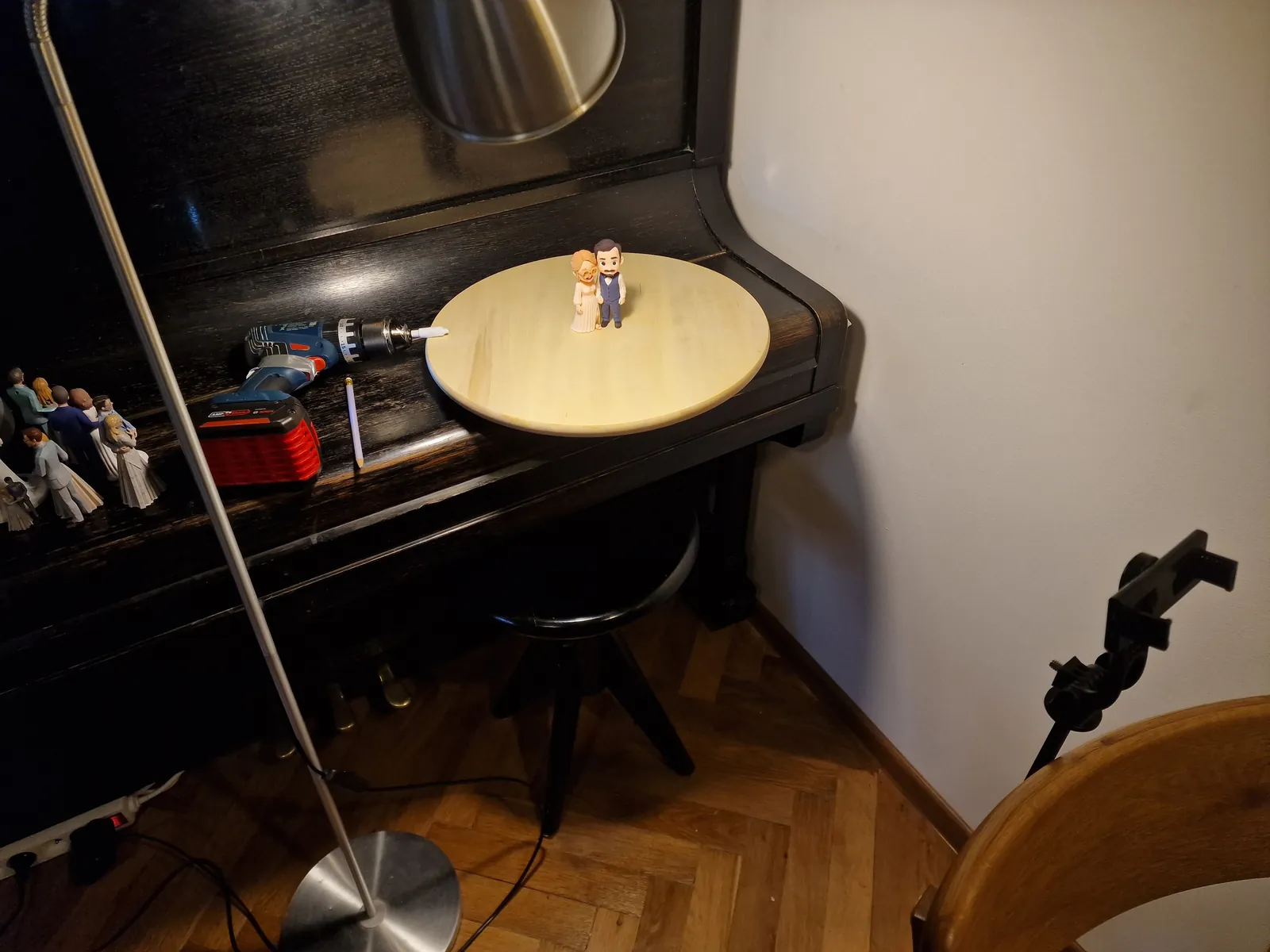 The turntable: a drill, a plywood disc, one lamp, a phone on a clamp
The scoring
A buyer asks two things. Does it look like a good product? Does it look like the people? We split each into 8 metrics, scored 0–10, each with one line of proof. For the people we scored face likeness per person, hair, and glasses. Then accessories, facial hair, and skin tone. Then expression and the uncanny factor. For the product we scored finish, paint, and sculpt detail. Then proportions, outfit match, and base. Then clean build and gift feel.
We scored each topper on its own, from its frames and photos only. We hid the prices, delivery tales, and vendor names. Averages came after. Then we showed each topper to the people it depicts and wrote what they said. Those verdicts are quotes, kept out of every score.
Cost and effort accounting
Every order shipped to one address in the Czech Republic. So the days and customs fees below are all for that one place. A vendor shipping inside its own country would likely be faster. It would likely be cheaper too. Costs are the full landed price in US dollars. They add shipping and customs where we paid them. We changed money at about $1.10 per euro. We used 23 CZK per dollar. Delivery days run from the order date. They end on the day the box came. Iteration rounds count times we wrote and a human wrote back. We left out auto-receipts. We left out dispatch notes. We left out out-of-office replies. Photo counts come from upload receipts and chat logs. We left them blank where no receipt exists. We did not guess.
How to read the comparison columns
Cost is the full landed price in US dollars. It adds shipping and customs. Days count from the order to a usable object. That means one you can hold. Iteration rounds count times we wrote and a human answered. Likeness and finish are 0–10 scores. Each is an average of 8 metrics. Our own unit sits in the table, marked Ours. We judged it on the same columns and cut points. It stays out of the study's counts. It stays out of the averages too.
Two scoring notes matter. Every hand-sculpted clay unit loses two points of finish. We scored from photos. Photos miss one flaw. Every handler named it on their own. The sculpted parts give under a thumb. That give makes a pricey object feel cheap. The Funko price covers two figures. One Funko figure is one person. Every other row is a couple.
Where this is weak
One lighting setup flatters matte surfaces. It can read gloss as a flaw. Likeness from photos of photos is noisy at the edges. So treat gaps under a point as nothing. Funko has no custom likeness by design. It scores low on metrics it never claimed. One delivery date is the SnapFigures replacement. The buyer reported it to the nearest half-week. It did not come from a carrier scan. And every parcel crossed a border to reach us. That loads the transit end of the numbers. It hits all 8.
We bought one unit per vendor. A studio that did poorly for us may do better. It could improve on the next order. A studio that did well may not repeat it. This is what 8 real orders looked like. It is not a promise about the ninth.